

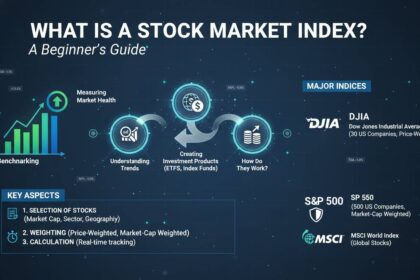

Understanding how financial markets work is essential for any investor, and at the heart of market analysis lies a fundamental tool: the stock market index. Whether you're reading about the Dow Jones Industrial Average in the morning news or checking the S&P 500 performance on your trading app, you've encountered these indices countless times. But what exactly is a stock market index, how is it calculated, and why does it matter for your investment decisions? This comprehensive guide breaks down everything you need to know about these critical financial benchmarks.
Understanding the Basics of a Stock Market Index
A stock market index is a numerical measurement that tracks the performance of a specific group of stocks, representing a particular segment of the financial market. Think of it as a report card that summarizes how a collection of companies is performing at any given moment. Rather than examining every single stock individually, investors and analysts use indices to gauge overall market sentiment, compare investment performance, and make informed decisions about where to allocate their capital.
Indices serve as benchmarks for the broader economy or specific sectors within it. When someone says "the market is up today," they typically refer to a major index like the S&P 500 or the NASDAQ Composite. These indices provide a quick snapshot of market health, allowing both novice and experienced investors to understand market movements without analyzing thousands of individual securities.
The composition of an index varies depending on its purpose. Some indices track the largest companies by market capitalization, while others focus on specific sectors like technology, healthcare, or energy. Some indices include only domestic companies, while others span multiple markets around the world. This diversity allows investors to measure performance against relevant benchmarks that align with their investment goals and risk tolerance.
How Stock Market Indices Are Calculated
Understanding how indices are calculated is crucial for interpreting their movements accurately. There are several methodologies used to determine index values, each with distinct characteristics that affect how the index reflects market reality.
The most common calculation method is market capitalization weighting, where companies are weighted according to their total market value. In this approach, larger companies have a more significant impact on the index's performance. The S&P 500 uses this methodology, meaning that a 10% move in Apple, the largest company in the index, will have a much greater effect than a 10% move in a smaller component.
Price weighting represents another traditional method, where stocks are weighted based on their share prices rather than their total market value. The Dow Jones Industrial Average uses this approach. While intuitive—higher-priced stocks naturally carry more weight—this method can be somewhat misleading, as a company with a high share price but small market capitalization can disproportionately influence the index.
Equal weighting gives each component the same importance regardless of size. The S&P 500 Equal Weight Index treats all 500 companies equally, meaning a small company moving 5% has the same impact as a large company moving 5%. Some investors prefer this approach because it provides more balanced exposure to the entire market.
Major U.S. Stock Market Indices
The United States hosts several of the world's most-watched stock market indices, each serving different purposes and representing various market segments.
The S&P 500 stands as the most widely followed index in the world, tracking 500 of the largest U.S. companies listed on the New York Stock Exchange or NASDAQ. It represents approximately 80% of the total U.S. market capitalization and is considered the best single gauge of large-cap U.S. equities. Index providers like Morningstar and others consider it the benchmark for the overall American economy.
The Dow Jones Industrial Average, created in 1896, is the oldest continuous major market index in the world. Despite its historical significance, it tracks only 30 large, well-established companies, making it less representative of the overall market than broader indices. The selection of these 30 companies is subjective and determined by the editors of The Wall Street Journal.
The NASDAQ Composite includes all common stocks and similar securities listed on the NASDAQ Stock Market, numbering over 3,000. Due to its heavy concentration in technology companies, it often serves as a barometer for the tech sector's performance. The NASDAQ-100, a subset of 100 of the largest domestic and international non-financial companies on the NASDAQ, provides a more focused view.
The Russell 2000 Index measures the performance of the 2,000 smallest companies in the Russell 3000 Index, representing the small-cap segment of the U.S. equity market. Many investors watch this index to gauge how smaller companies are performing relative to their larger counterparts.
Why Stock Market Indices Matter for Investors
Stock market indices serve multiple critical functions in the investment landscape, making them indispensable tools for both individual and institutional investors.
First and foremost, indices provide performance benchmarks. Professional money managers are typically evaluated against relevant indices, and individual investors can measure their portfolio performance against these benchmarks to determine whether they are outperforming or underperforming the market. If your portfolio returns 8% annually while the S&P 500 returns 12%, you know your investments are underperforming the broad market.
Indices also enable passive investing strategies. Rather than trying to pick individual winning stocks, investors can purchase index funds or exchange-traded funds (ETFs) that replicate an index's performance. This approach, championed by investing legends like John Bogle, founder of Vanguard, has proven competitive with actively managed funds over long periods while offering lower fees.
Market indices serve as economic indicators as well. Because they represent the collective value of major companies, their movements often signal broader economic trends. Rising indices generally indicate investor confidence in future economic growth, while falling indices may reflect economic concerns or uncertainty.
Types of Index Methodologies and Their Implications
Beyond the basic calculation methods, indices can be categorized by their construction philosophy and rebalancing schedules, each carrying implications for investors.
Growth indices focus on companies exhibiting characteristics associated with growth, such as high earnings growth rates or revenue expansion. Value indices, conversely, track companies considered undervalued relative to their fundamentals, often with lower price-to-earnings ratios or price-to-book values. The distinction matters because different market conditions favor different styles—growth stocks often outperform during bull markets, while value stocks may provide better returns during economic downturns.
Sector-specific indices track companies within particular industries, allowing investors to concentrate on areas they believe will outperform or to diversify across sectors. Technology indices, healthcare indices, financial indices, and energy indices each provide targeted exposure to specific segments of the economy.
International indices extend beyond U.S. borders, tracking markets in Europe, Asia, and emerging economies. The MSCI Emerging Markets Index and the FTSE Global All Cap Index help investors gauge international market performance and allocate assets across global markets.
Index Funds and ETFs: Bringing Indices to Individual Investors
The democratization of index investing has transformed how ordinary people participate in the stock market. Index funds and ETFs have made it possible for anyone to invest in a diversified portfolio that tracks a major index, regardless of their expertise or capital available.
Index mutual funds pool investor money to purchase all or a representative sample of the securities in an index. They offer instant diversification, low turnover, and minimal fees compared to actively managed funds. The proliferation of index funds has driven fees down across the entire mutual fund industry, saving investors billions of dollars annually.
Exchange-traded funds operate similarly to mutual funds but trade on stock exchanges throughout the day like individual stocks. This liquidity makes ETFs particularly attractive for investors who want to enter or exit positions quickly. ETFs have experienced tremendous growth over the past two decades, with assets under management reaching into the trillions of dollars.
According to data from the Investment Company Institute, index mutual funds and ETFs have seen consistent net inflows as investors increasingly recognize the benefits of passive, low-cost investing. This shift represents one of the most significant changes in the investment industry over the past generation.
Historical Evolution of Stock Market Indices
Stock market indices have evolved considerably since the first ones were created in the late 19th century, reflecting changes in technology, market structure, and investor needs.
The Dow Jones Industrial Average was created by Charles Dow and Edward Jones in 1885, originally tracking nine railroad companies and two industrial firms. The concept was revolutionary—instead of tracking every stock, Dow proposed using a representative sample to gauge market health. This innovation laid the foundation for modern index investing.
The S&P 500 was launched in 1957 by Standard & Poor's, building on an earlier index of 90 companies created in 1923. Its broader scope and more sophisticated methodology made it the preferred benchmark for institutional investors and remains so today.
The NASDAQ emerged in 1971 as the world's first electronic stock market, and its composite index quickly became synonymous with the technology sector's performance. The NASDAQ's rise paralleled the growth of the technology industry, making it a focal point during the dot-com boom and bust of the late 1990s and early 2000s.
Modern indices now incorporate sophisticated screening criteria, factor-based approaches, and environmental, social, and governance (ESG) considerations. There are indices tracking companies with strong female leadership, those meeting carbon emission thresholds, and those adhering to various religious or ethical principles.
Conclusion
Stock market indices represent one of the most important innovations in financial history, providing investors with essential tools for measuring performance, allocating assets, and understanding market dynamics. From the 30 companies in the Dow Jones Industrial Average to the thousands tracked by broader indices, these benchmarks offer valuable insights into how the market operates and where economic opportunities may lie.
Whether you choose to invest through index funds, analyze indices to inform individual stock selection, or simply track them to understand economic trends, understanding what stock market indices are and how they work is fundamental to financial literacy. As the investment landscape continues to evolve, indices will undoubtedly adapt, but their core purpose—providing a clear, comparable measure of market performance—will remain essential for investors at every level.
Frequently Asked Questions
What is the difference between the Dow Jones and S&P 500?
The Dow Jones Industrial Average tracks only 30 large companies and uses price weighting, meaning higher-priced stocks have more influence. The S&P 500 tracks 500 companies using market capitalization weighting, making it more representative of the overall U.S. market and the preferred benchmark for most investors.
Can I invest directly in a stock market index?
You cannot invest directly in an index itself since indices are just measurements, not investable securities. However, you can invest in index funds or ETFs that replicate an index's performance, giving you the same returns as the index minus small fees.
How often do indices rebalance their component stocks?
Rebalancing frequency varies by index. The S&P 500 undergoes quarterly reviews and can add or remove companies at any time if warranted. Other indices may rebalance monthly, semi-annually, or annually. Some indices have strict rules about market capitalization thresholds for inclusion.
What does it mean when an index reaches an all-time high?
When an index reaches an all-time high, it means the combined value of its components is higher than at any previous point in the index's history. This indicates strong investor sentiment and typically reflects positive expectations about future corporate earnings and economic conditions, though it doesn't predict future market direction.
Why do different indices sometimes show different performance on the same day?
Different indices contain different stocks and use different weighting methodologies. If technology stocks perform well on a particular day, the NASDAQ will likely rise more than the Dow, which has less tech exposure. Similarly, if small-cap stocks outperform large-caps, the Russell 2000 may advance while the S&P 500 remains flat.
Are stock market indices a reliable indicator of economic health?
While not perfect indicators, stock market indices provide valuable insights into economic health because they reflect aggregate corporate valuations. Rising indices typically signal confidence in future economic growth, while falling indices may indicate concerns. However, indices can be influenced by factors beyond pure economic fundamentals, including interest rates, geopolitical events, and speculative movements.